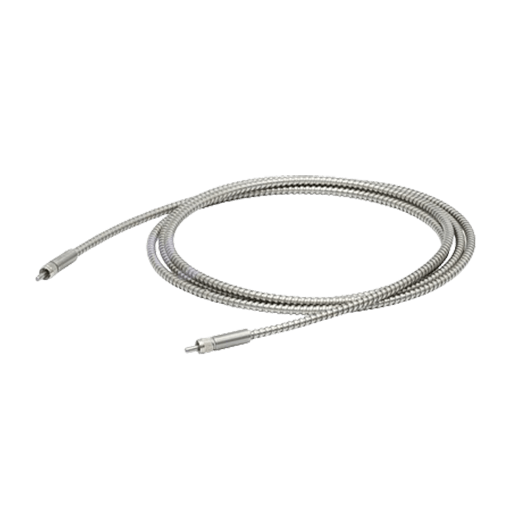
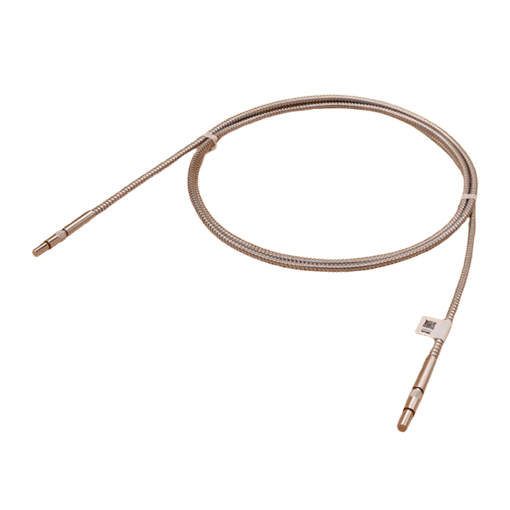
“Solarization” (or photodegradation) refers to the formation of defect centers in the fiber under prolonged light exposure, resulting in reduced transmission. These defects are more likely to form when fibers are exposed to ultraviolet light below 300 nm. Compared to standard fibers, UV-resistant fibers provide superior resistance to UV radiation and are ideal for applications such as:
- Pollution analysis
- Chemical processing
- UV lithography
- Medical diagnostic spectroscopy
Standard fibers suffer significant transmission loss under UV exposure, whereas UV-resistant fibers maintain higher transmission efficiency.
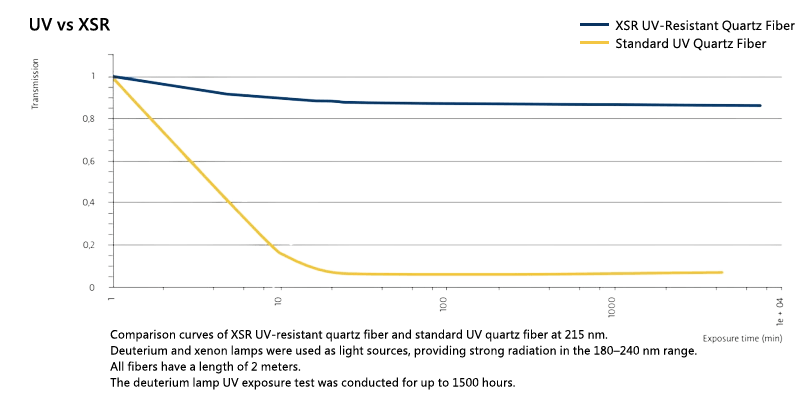
For optimal performance, pre-irradiation is recommended to stabilize initial attenuation. The exposure time depends on the light source and power. Once stabilized, the fiber can be used normally.
-
Specification
| Abbrev. | Type | Core dia. | Cladding dia. | Coating dia. | Coating material | Wavelength range | Operating temp. |
| XSR | UV-resistant / High-temp | 100 μm | 110 μm | 160 μm | Polyimide | 185–1100 nm | -190 ~ +350°C |
| 200 μm | 220 μm | 240 μm | |||||
| 400 μm | 440 μm | 480 μm | |||||
| 600 μm | 660 μm | 710 μm |
-
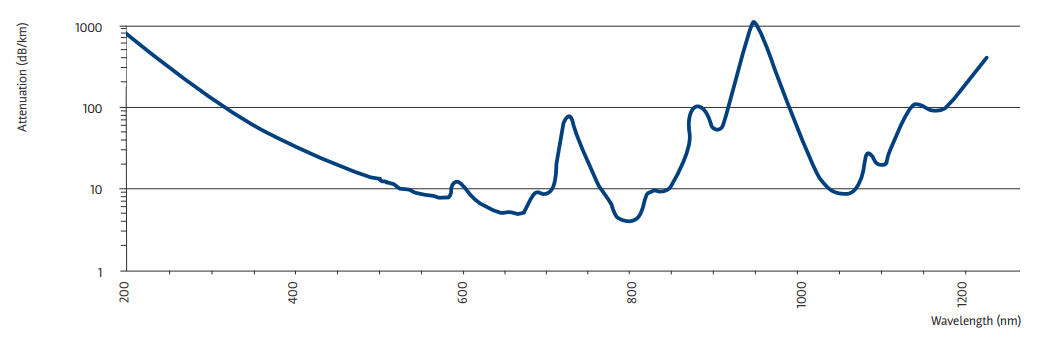
UV-Resistant Quartz Fiber Attenuation Curve