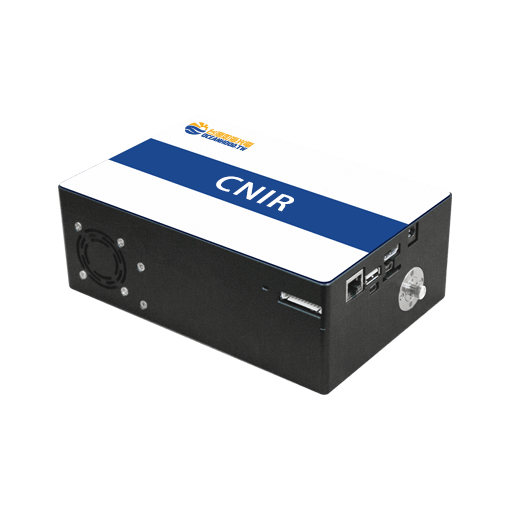
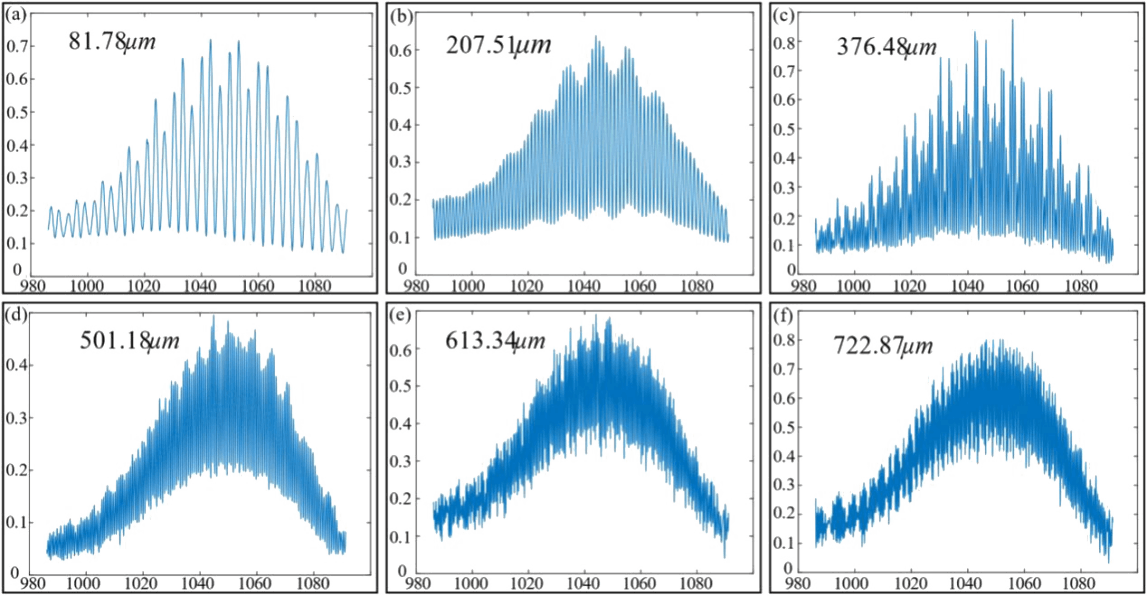
The CNIR High-Speed Near-Infrared Spectrometer is designed for high-precision measurement and industrial integration. Covering the 1525–1575 nm spectral range, it is optimized for the C-Band near-infrared region and features high-speed spectral acquisition, high optical resolution, and real-time Ethernet communication. The system can be seamlessly integrated into automated production lines, enabling real-time monitoring of millisecond-scale spectral changes, including thin-film thickness and laser wavelength.
CNIR is suitable for applications such as thin-film thickness measurement, industrial gas monitoring, liquid composition analysis, and biomedical research, delivering a fast, accurate, and reliable near-infrared spectroscopy solution for industrial and scientific applications.
-
Features
- Optimized for the C-Band: Covers the 1525–1575 nm spectral range and is optimized for the C-Band near-infrared region. Optimized for the characteristic absorption bands of various hydrogen-containing functional groups, making it ideal for near-infrared spectroscopy and analytical applications.
- High optical resolution: A specially designed optical system delivers optical resolution of up to 0.3 nm, enabling clear differentiation of fine thin-film interference spectral features for enhanced measurement resolution.
- High-speed acquisition at 3000 fps: A high-speed electronic architecture enables spectral acquisition at up to 3000 fps, allowing real-time capture of millisecond-scale spectral changes.
- Flexible connectivity: Equipped with Gigabit RJ45 Ethernet and a 24-pin expansion interface, the system supports high-speed data transmission, remote control, and secondary development, enabling remote monitoring and real-time data visualization.
-
Applications
- Thin film thickness measurement
- Fiber laser and optical communication device testing
- Rapid moisture and organic solvent analysis
- Scientific research and material identification
-
Specification
| Optical parameters | |
| Spectral range | 1525 - 1575 nm |
| Resolution | ~ 0.35 nm |
| Fiber insertion repeatability | ≤7% |
| Functional parameters | |
| A/D sampling | 16 bit |
| Data interface | RJ45 Gigabit |
| Expansion interface | 24PIN |
| Acquisition modes | Single acquisition, continuous acquisition, software trigger, synchronous external trigger, asynchronous reset external trigger |
| Integration time | 100 µs-30 s |
| CCD dark noise1 | ≤30 |
| Spectral dynamic range2 | 3500:1 |
| Signal-to-noise ratio3 | 2000:1 |
| Response linearity4 | ≥99 % |
| Other parameters | |
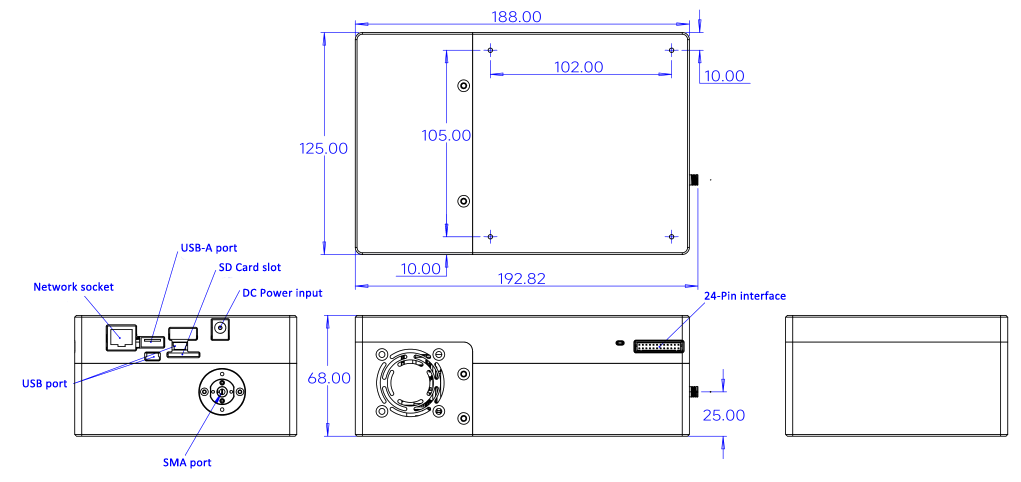
| Dimensions | 188×125×68 mm |
| Operating temperature | 0℃~40℃ |
| Operating humidity | 20%-85% |
| 1. CCD readout noise: RMS value of CCD readout noise at minimum integration time. 2. Spectral dynamic range: Calculated under minimum integration time as (Saturation value – Dark noise baseline) / Standard deviation of CCD readout noise. Evaluation method follows Oceanhood corporate standard. 3. Signal-to-noise ratio (SNR): Actual measured value according to Oceanhood’s internal evaluation standard. 4. Response linearity: Measured before calibration. |
|
-
Dimensional drawing

-
Typical applications
In agriculture and food sectors, it can quickly quantify the fat, carbohydrates, and protein content in grains, oils, fruits, and vegetables, used for quality grading and origin traceability;
In petrochemical industries, it can distinguish the ratios of saturated and unsaturated hydrocarbons in gasoline and diesel, monitor hydrocarbon composition and nitrogen compounds in crude oil, supporting online blending and quality control;
In biomedicine, it can non-destructively detect active ingredients and protein content in drug tablets and can be used for non-invasive analysis of proteins and other components in human tissues;
In polymer materials, it can characterize methyl/methylene content, crystallinity, and amine additives in polymers, aiding material research and development and production quality control.
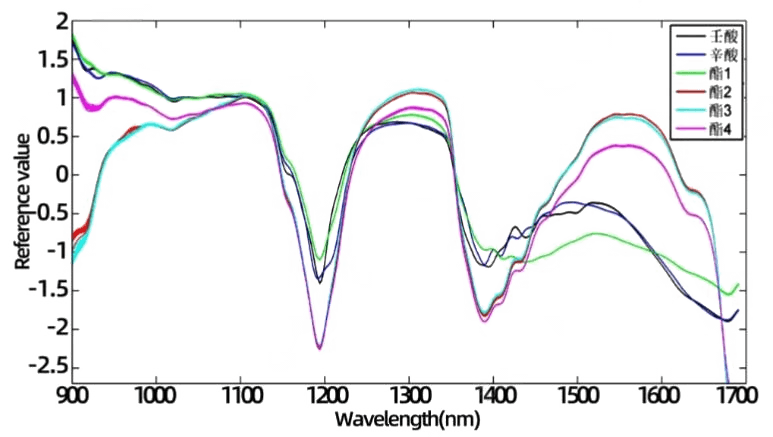
This band has been used for rapid determination of protein/amino acid content (N–H), authentication of polyamide and nylon (N–H), monitoring of C–H microenvironments in materials containing aromatic rings or olefins, and simultaneous analysis of moisture and organic components in drugs, typical fields including food, feed, textiles, pharmaceuticals, and polymer process control.