
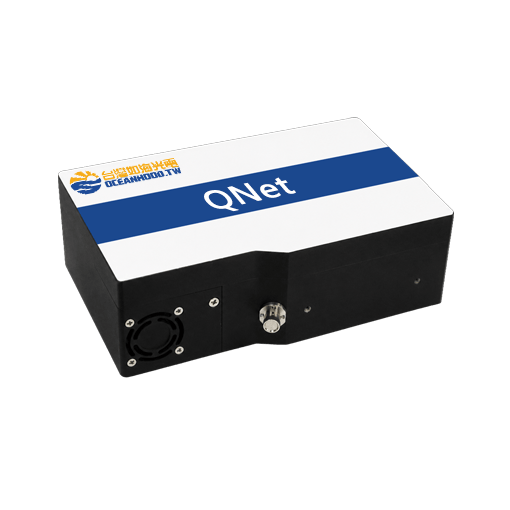
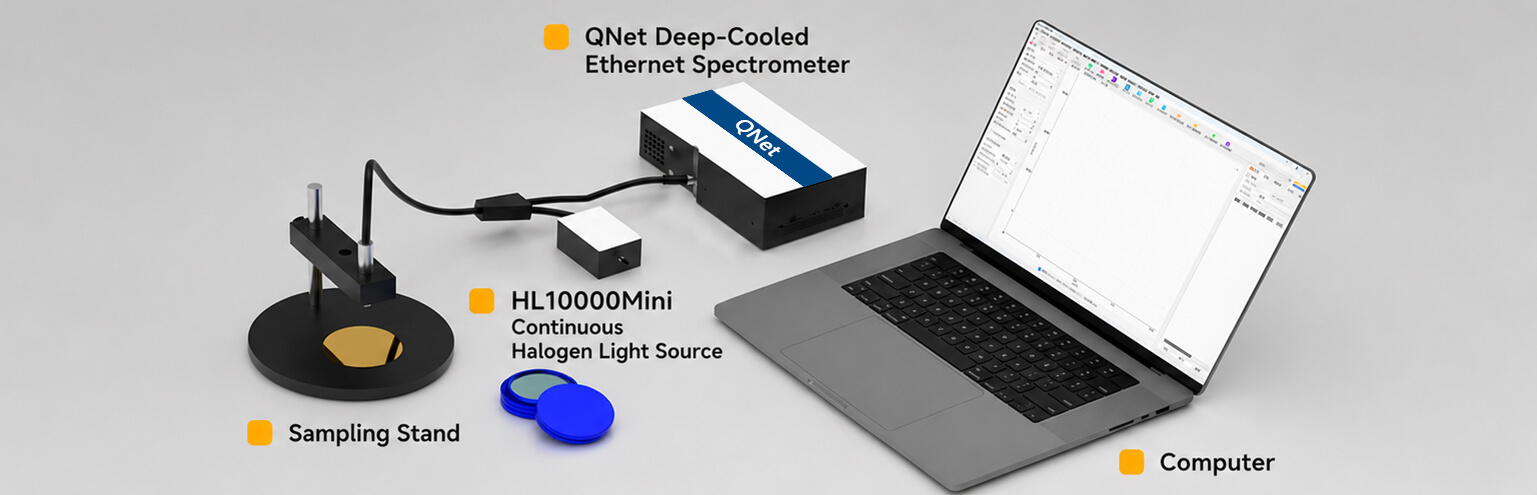
QNet Deep-Cooled Ethernet Spectrometer is a high-performance fiber optic spectrometer featuring a high signal-to-noise ratio and wide dynamic range for demanding spectroscopy applications. Compatible with a variety of light sources, including lasers, tungsten-halogen lamps, and deuterium lamps, it can be easily integrated into a wide range of spectroscopy systems. Its versatile design makes it well suited for scientific research, industrial inspection, and other optical measurement applications requiring high performance and system flexibility.
-
Features
- Deep TEC cooling to -25°C minimizes dark current and detector noise.
- 1024×58 pixel CCD detector provides high sensitivity and excellent measurement stability.
- 18-bit A/D converter with a dynamic range of up to 36000:1.
- High signal-to-noise ratio (SNR ≥1500:1) for weak optical signal detection.
- Low stray light (~0.3%) improves spectral accuracy.
- Configurable 10, 25, 50, 100, and 200μm slit widths for optimized spectral resolution.
- Supports single, continuous, software trigger, synchronous external trigger, and asynchronous external reset acquisition modes.
- Integrated high-speed Ethernet and serial communication interfaces, standard 24-pin I/O interface, and dedicated DAC/ADC enabling light source control, intensity regulation, and power feedback.
-
Specification
| Model | QNet |
| A/D conversion | 18-bit |
| CCD readout Noise 1 | ≤7 RMS |
| Dynamic range 2 | 36,000:1 |
| Signal-to-Noise ratio 3 | ≥1500:1 |
| Integration time | 8 ms ~ 30 min |
| Acquisition modes | Single acquisition, continuous acquisition, software trigger, synchronous external trigger, asynchronous reset external trigger |
| Linearity 4 | ≥98% |
| Fiber connector | Key-SMA905 |
| Detector | 1024 × 58 Pixels CCD |
| Stray light | ~0.3% |
| Fiber plugging repeatability | ≤7% |
| Data interface | RJ45、RS232 |
| Expansion interface | 24PIN |
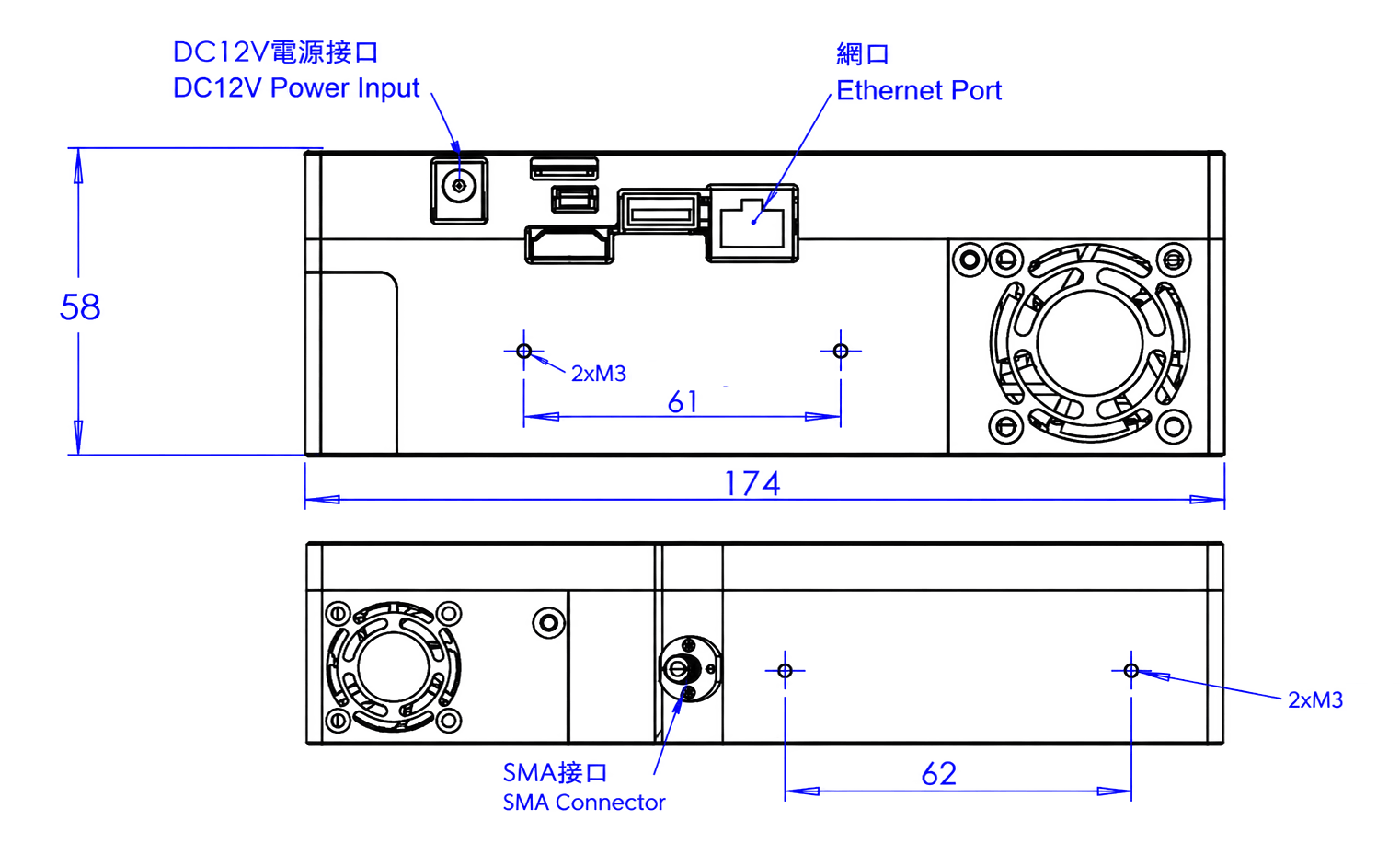
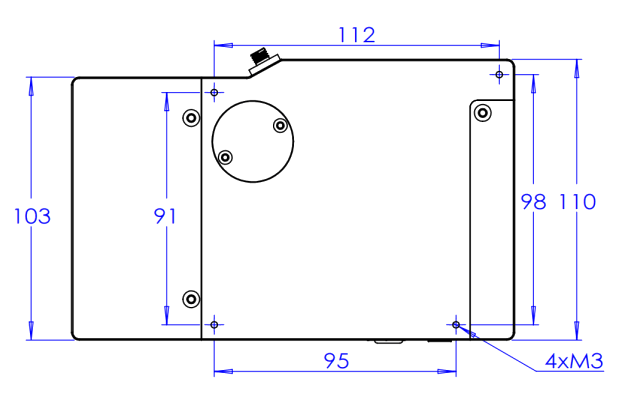
| Dimensions | 174 × 110 × 58 mm |
| Operating temperature | 0~40°C |
| Operating humidity | 20~85% RH |
| 1. CCD readout noise: RMS value of the CCD readout noise measured at the minimum integration time. 2. CCD dynamic range: measured at the minimum integration time and calculated as (saturation level − dark noise baseline) / standard deviation of CCD readout noise. The evaluation method follows Oceanhood's internal testing standard. 3. Signal-to-noise ratio (SNR): the evaluation and calculation method follow Oceanhood's internal testing standard. 4. Response nonlinearity: specified before calibration. |
|
-
Configurations
| Model |
Wavelength range/nm | Spectral resolution/nm | ||||
| Start | End | 10 µm | 25 µm | 50 µm | 100 µm | |
| QNet-350-1100 | 350 | 1100 | - | 1.60 | 2.20 | 3.50 |
| QNet-795-1030 | 790 | 1030 | - | 0.60 | - | 0.90 |
| QNet-790-930 | 790 | 930 | - | 0.50 | 0.80 | 0.85 |
| QNet-535-625 | 535 | 625 | - | 0.25 | 0.35 | 0.70 |
| QNet-190-980 | 190 | 980 | 1.30 | 1.80 | 2.20 | 3.50 |
| QNet-650-800 | 650 | 800 | 0.30 | - | - | 0.76 |
Notes
1. The configurations listed above are standard pre-configured models. Before placing an order, the model number can be specified using the format QNet-Start Wavelength-End Wavelength-Slit Width. For example, a spectrometer with a 350 nm start wavelength, 1100 nm end wavelength, and 50 μm slit width is designated as QNet-350-1100-50.
2. Customers may select the appropriate grating and slit width according to their application requirements. Oceanhood can perform optical simulations based on the selected configuration to recommend the optimal grating, slit, and spectrometer specifications.
3. The listed spectral resolutions are for reference only. Actual performance may vary depending on the optical configuration and manufacturing tolerances.
-
Dimensional drawing
-
Applications
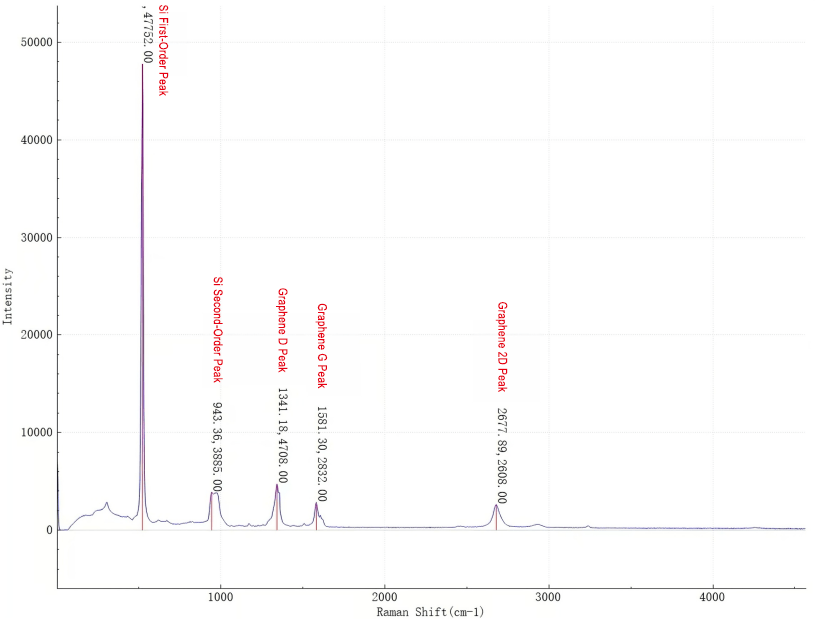
Weak Raman and fluorescence analysis
With its high signal-to-noise ratio and low detector noise, the QNet series is ideal for weak Raman scattering and fluorescence measurements in graphene, carbon nanotubes, advanced materials, biomedical research, and pharmaceutical development, delivering laboratory-grade detection sensitivity.。
With its high signal-to-noise ratio and low detector noise, the QNet series is ideal for weak Raman scattering and fluorescence measurements in graphene, carbon nanotubes, advanced materials, biomedical research, and pharmaceutical development, delivering laboratory-grade detection sensitivity.。
Optical thin film and material characterization
In the manufacturing and R&D of high-end optical coatings, OLED display panels, and photovoltaic modules, the QNet series is widely used for thin-film thickness measurement and spectral analysis of reflectance and transmittance.
In the manufacturing and R&D of high-end optical coatings, OLED display panels, and photovoltaic modules, the QNet series is widely used for thin-film thickness measurement and spectral analysis of reflectance and transmittance.
Transient spectroscopy and combustion diagnostics
Designed for applications such as metallurgical analysis, combustion efficiency monitoring, engine diagnostics, and plasma emission spectroscopy, the QNet series provides excellent performance for transient optical signals under complex background radiation conditions.
Designed for applications such as metallurgical analysis, combustion efficiency monitoring, engine diagnostics, and plasma emission spectroscopy, the QNet series provides excellent performance for transient optical signals under complex background radiation conditions.
Environmental and water quality monitoring
The QNet series is well suited for distributed monitoring applications, including heavy metal detection in surface water, Continuous Emissions Monitoring Systems (CEMS), marine observation, and environmental sensing. Its Gigabit Ethernet architecture enables reliable remote data acquisition and network-based spectroscopy systems.
The QNet series is well suited for distributed monitoring applications, including heavy metal detection in surface water, Continuous Emissions Monitoring Systems (CEMS), marine observation, and environmental sensing. Its Gigabit Ethernet architecture enables reliable remote data acquisition and network-based spectroscopy systems.